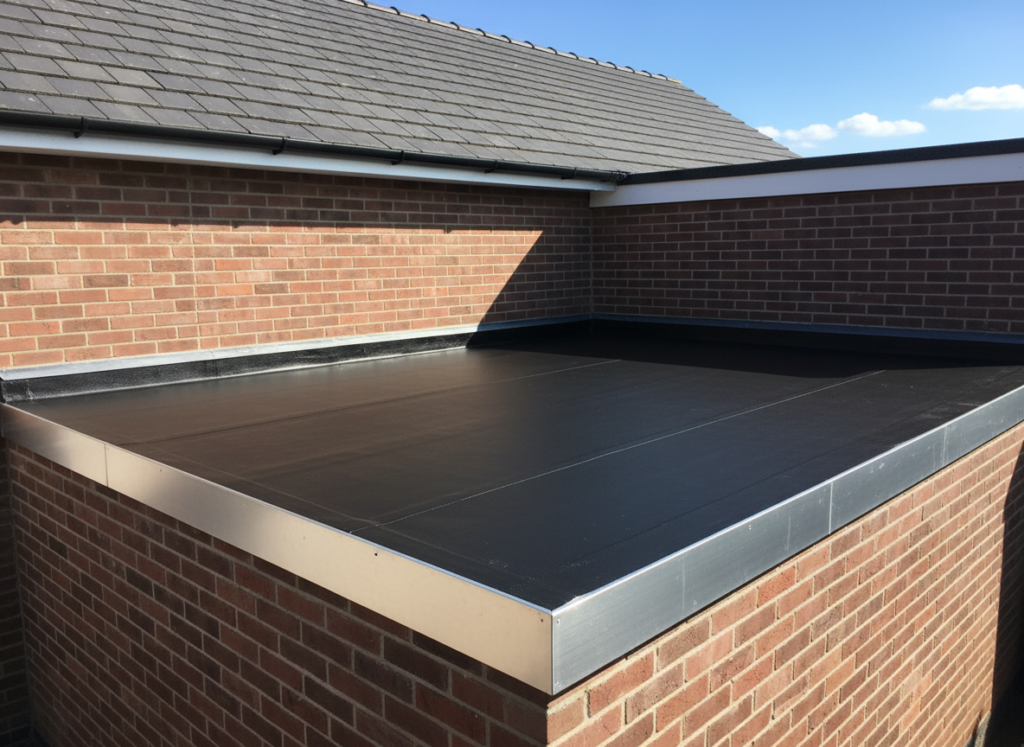
Three coverings dominate domestic flat roofing in the UK, and the choice between them is less about which is best and more about which suits the deck, the shape and the detailing of your particular roof. EPDM is a single-sheet rubber membrane best suited to simple rectangular roofs with few penetrations. GRP is a fibreglass laminate formed in place, suited to roofs with complex edges and upstands. Torch-on felt is a multi-layer bitumen membrane, the most repairable of the three and the most tolerant of an imperfect substrate. All three will outlast a single-layer felt roof by a wide margin, and all three fail at the details rather than in the field.
That last point is the one worth carrying through the whole decision. Flat roofs almost never leak in the middle. They leak at upstands, outlets, kerbs, junctions and around rooflights. The covering material matters, but the standard of the detailing matters more.
EPDM rubber membrane
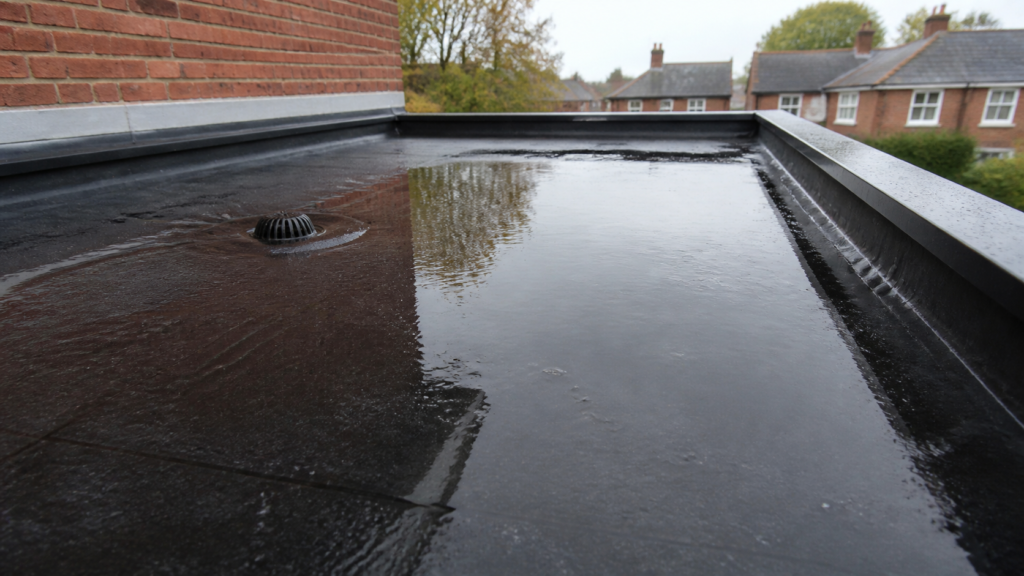
EPDM is a synthetic rubber supplied in large sheets, bonded to the deck with adhesive. On most domestic extensions and garages the whole roof can be covered by a single piece with no seams at all, which removes the most common leak path before the job starts.
Where it works well
- Simple rectangular roofs: extensions, garages, dormer tops, porches.
- Roofs with few penetrations, because every pipe, outlet and upstand needs a separately formed and bonded detail.
- Properties where minimal disruption matters, as there is no flame and no hot work involved.
Where it is less suited
- Complex shapes with multiple corners and changes of level, where the number of formed details undermines the seamless advantage.
- Roofs that will be walked on regularly. EPDM is not a hard-wearing surface and is vulnerable to puncture by dropped tools, ladder feet or garden furniture.
EPDM is flexible across a wide temperature range and copes well with thermal movement, which is useful on a south-facing Kent extension roof. Manufacturers commonly quote service lives well in excess of twenty years for correctly installed systems, though as with all three coverings the installation standard is the variable that matters most.
GRP fibreglass
GRP, glass reinforced plastic, is laid wet. Chopped strand matting is laid over an OSB deck and saturated with resin, then finished with a pigmented topcoat. It cures into a single rigid laminate with no joints anywhere, including around upstands and outlets, because the detail is formed in the same continuous material as the field.
Where it works well
- Complex roofs with upstands, kerbs, multiple corners and integral drip edges.
- Balconies and roof terraces, because the cured surface is hard and can take foot traffic when specified for it.
- Roofs where a neat, uniform finished appearance is visible from a window above.
Where it is less suited
- Roofs with significant thermal movement or a deck that flexes. GRP is rigid, and rigid materials crack when the substrate underneath them moves.
- Overlaying an existing covering. GRP normally requires a new, correctly laid OSB deck, so the old covering and deck usually have to come off.
- Cold or damp weather installation. The resin needs suitable conditions to cure properly, which in a Kent winter can mean waiting.
The rigidity point is the one that decides most GRP jobs. On a well-built, properly supported deck it is excellent. On an old, springy joisted roof that was never designed for it, cracking at the joist lines is a known failure mode.
Torch-on felt (reinforced bitumen membrane)
Modern torch-on systems bear almost no relation to the single-layer mineral felt that gave flat roofs their reputation. A proper system is two or three layers of polyester or glass-reinforced bitumen membrane, heat-bonded in overlapping sheets, finished with a mineral-surfaced cap sheet.
Where it works well
- Larger and more complex roofs, including commercial work, where the system’s track record is longest.
- Roofs where future repairability matters. A damaged area can be cut out and a patch heat-bonded in permanently by any competent flat roofer.
- Substrates that are not perfectly flat or stable, because multiple layers accommodate more imperfection than a single rigid laminate.
Where it is less suited
- Anywhere hot work is a concern. Torching involves an open flame near timber and requires proper hot works procedure. Some sites and some insurers restrict it.
- Roofs where appearance is a priority, as the mineral finish is more utilitarian than a smooth GRP topcoat.
The three side by side
| EPDM rubber | GRP fibreglass | Torch-on felt | |
|---|---|---|---|
| Form | Single bonded sheet | Laminate cured in place | Two or three bonded layers |
| Seams in the field | Usually none | None | Lapped and heat-bonded |
| Best shape | Simple rectangles | Complex, with upstands | Any, including large areas |
| Deck required | Sound, smooth substrate | New OSB deck, rigid | Tolerant of minor imperfection |
| Foot traffic | Poor unless protected | Good if specified for it | Moderate |
| Movement tolerance | High | Low | Moderate to high |
| Repairability | Patch bonded, needs care | Local resin repair, colour match variable | Straightforward hot patch |
| Hot work on site | None | None | Yes, open flame |
| Weather sensitivity when installing | Needs dry deck | Needs dry and warm enough to cure | Needs dry deck |
The decision usually turns on the deck, not the covering
Before any of the three is chosen, the deck needs assessing. On most domestic flat roofs the failure that brought you here started with water sitting on the roof for years, and the timber underneath it is rarely in the condition the owner expects.
Three things get established first:
- Is the deck sound? Soft, delaminated or springy boarding has to come off regardless of what goes on top.
- Are the falls adequate? A flat roof is not flat. It needs a fall towards the outlets, and ponding water is the reason many coverings fail early. Correcting the falls with firrings is a deck job, not a covering job.
- Is it a warm deck or a cold deck? This determines where the insulation sits and where the vapour control layer goes, and getting it wrong causes interstitial condensation that rots the roof from inside while the covering looks perfect.
If the deck needs replacing, GRP becomes viable where it previously was not, because a new deck is being laid anyway. If the deck is sound but not perfectly flat, EPDM or felt is usually the more sensible answer. That is how the choice is normally made in practice.
Insulation and the building regulations
Replacing a flat roof covering is very likely to be notifiable work. In England, stripping and re-covering more than 25% of a roof is treated as a material alteration under the Building Regulations, and a domestic flat roof re-cover almost always exceeds that. It normally triggers two things: notification to building control at the relevant Kent district or borough council, and an obligation to improve the thermal performance of the roof where it is reasonably practicable. Our guide to what roof work needs building control approval in Kent sets out which council handles it and what the notification involves.
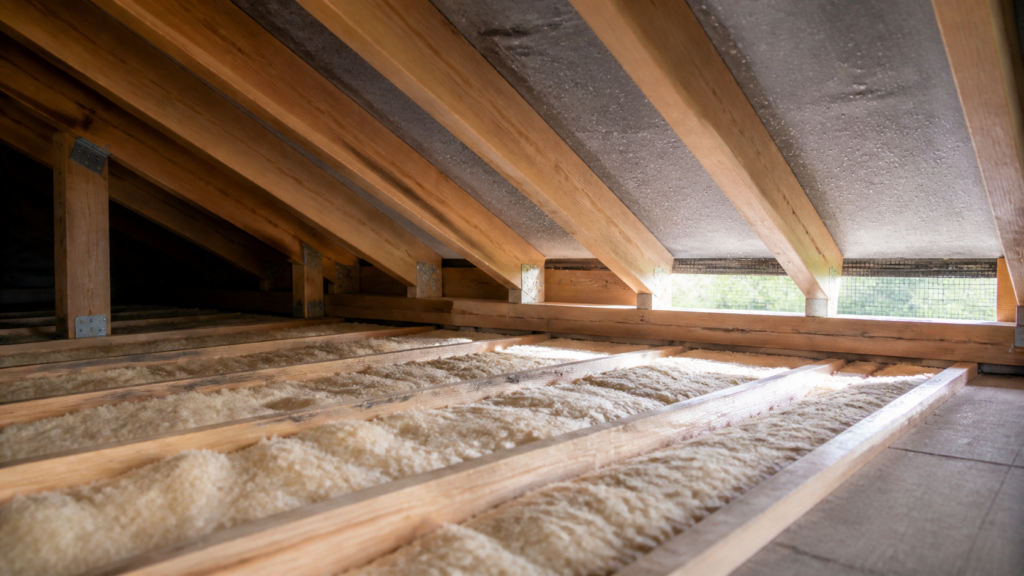
In practice that usually means insulating above the deck as a warm roof, which raises the roof level and has consequences for upstand heights, door thresholds, rooflight kerbs and the abutment with the wall above. It is far better designed in at quotation stage than discovered halfway through. Our page on roof insulation and ventilation sets out why the vapour control layer and the ventilation strategy have to be decided at the same time as the insulation.
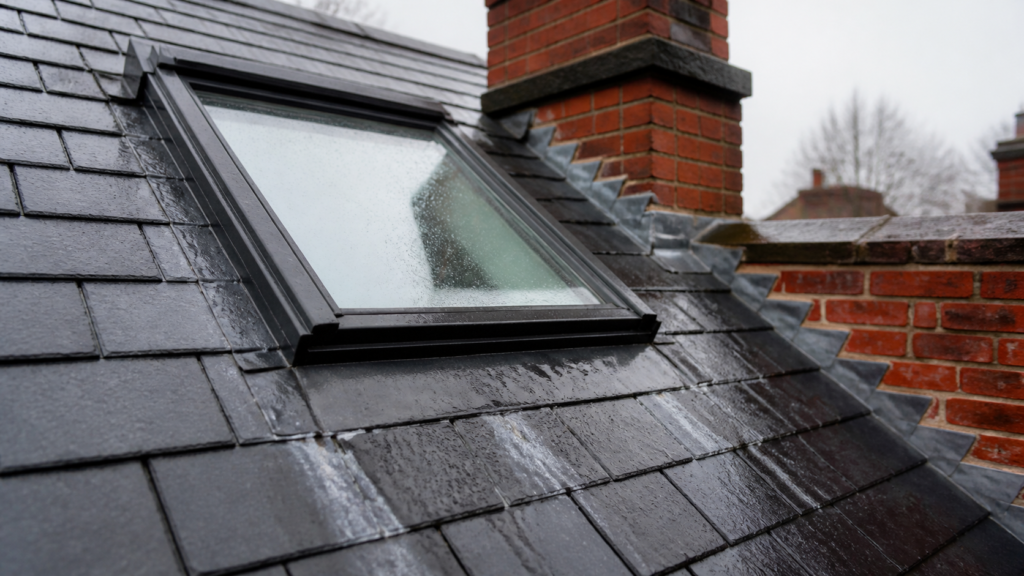
If the roof includes or will include rooflights, the kerb detail is where flat roofs most commonly leak, and it needs to be designed as part of the covering rather than cut in afterwards. See skylight and roof window installation for how that is handled.
Choosing for a Kent property
A few local considerations shift the balance.
Exposure. Coastal roofs in Thanet, Whitstable, Herne Bay, Folkestone and Deal take sustained wind and salt. Perimeter fixing and edge trim specification matter more here than the covering itself, because wind uplift attacks edges first.
Trees. Wealden and Downs properties with mature tree cover get persistent leaf litter and standing debris. Outlets need to be accessible and generously sized, and the roof needs to be on a maintenance rota rather than forgotten about. The same tree cover is why moss and organic debris build up so readily on Kent roofs, and on a flat roof it collects at the outlets instead of washing off.
Conservation areas. In Canterbury, Tunbridge Wells, Faversham, Sandwich, Rochester and other designated areas, a flat roof visible from a public vantage point may have appearance conditions attached. Your local planning authority will confirm what applies.
The short version
For a simple rectangular extension or garage roof with a sound deck, EPDM is usually the straightforward answer. For a roof with complex upstands, a new deck, or one that will be walked on, GRP earns its place. For larger, more complex or less predictable roofs, and where easy future repair is worth having, a multi-layer torch-on system remains a very sound choice.
Any of the three will perform for decades if the falls are right, the deck is sound, the insulation is correctly specified and the details are properly formed. None of them will if those things are wrong.
We arrange a free roof survey across Kent, from the coastal towns to Medway and the Weald, including an assessment of the deck and the falls, so that the covering recommendation is based on your roof rather than on a preferred product. The work is carried out by approved roofing specialists who are fully insured and appropriately qualified. See flat roofing for the systems we install, new roof installation and re-roofing where a full replacement is involved, or get in touch to book a free roof survey.