Nail sickness is the failure of the nails holding a slate roof together, not the failure of the slates. The slates stay sound, often for well over a century, while the fixings corrode and fatigue until they can no longer carry the weight. Slates then begin to slip, one or two at a time, usually with no storm to explain it. That is why patching a nail-sick roof never holds: you are fixing the symptom while the cause carries on quietly across the rest of the slope.
It is one of the most common findings on Kent’s older housing stock, and one of the most misdiagnosed. A homeowner sees a gap, calls someone out, has a slate put back, and repeats the exercise every few months without ever being told what is actually happening.
What is going on up there
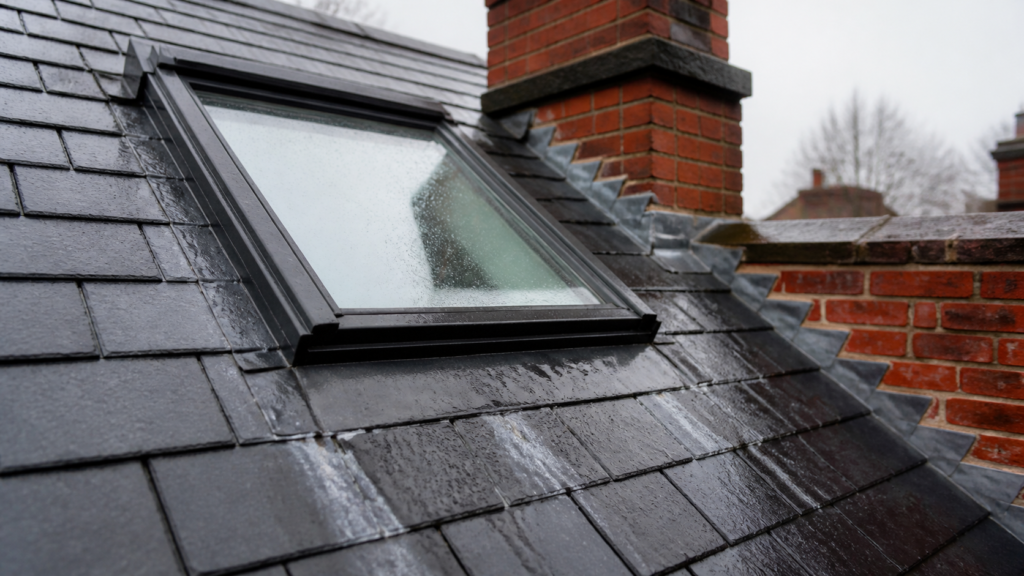
A slate is held by two nails driven through it into a timber batten. The nail carries the weight of the slate and resists the wind uplift trying to peel it off. Over decades the shank corrodes and thins, particularly where it passes through the slate and meets moisture running down the surface. Eventually the head shears off, or the remaining shank cannot hold the load, and the slate slides.
The important detail is that this is a whole-roof condition. The nails on a slope were all driven on the same day, from the same batch, into the same timber, and exposed to the same weather ever since. When one reaches its limit, the rest are not far behind. That single fact explains everything else about how nail sickness behaves.
Which nails fail, and when
Older roofs were commonly fixed with iron or mild steel nails, sometimes galvanised. Galvanising is a sacrificial coating: once it has gone, the steel beneath corrodes quickly. Copper, aluminium and stainless steel last far longer, but none of them was standard on Victorian work.
Why Kent sees so much of it
Kent’s Victorian and Edwardian expansion produced street after street of red-brick terraces roofed in Welsh slate. You see it across Canterbury, the Medway towns, Maidstone, Ashford, Gravesend, Folkestone, Dover and the older parts of Tunbridge Wells. Those roofs are now between roughly 110 and 140 years old, which is squarely within the window where original steel fixings give out.
Two Kent-specific factors accelerate it:
- Salt-laden air. Along the coast at Whitstable, Herne Bay, Margate, Ramsgate, Deal and Folkestone, and up the estuary through Sheerness and Gravesend, airborne salt speeds up corrosion of ferrous fixings considerably. Coastal slate roofs commonly become nail sick earlier than identical inland ones.
- Wet, mild winters. Kent’s maritime climate produces many cycles of wetting and drying rather than long hard freezes. Repeated wet and dry cycling is exactly what corrodes a nail shank.
Add the fact that many of these roofs were laid without any underlay, so the back of the slate and the head of the nail are exposed to whatever moves through the roof space, and the pattern becomes very predictable.
How to recognise it from the ground
You do not need to go up, and you should not. Almost every reliable sign of nail sickness is visible from the pavement or the garden.
- Slates slipping in no particular pattern, scattered across the slope rather than clustered around a chimney or valley.
- Slipping in ordinary weather. A slate that comes down on a still day has not been blown off, it has been dropped. Losses that only ever appear after a gale are a different matter, and how storm damage to a Kent roof is assessed and claimed follows a different route.
- A slate that has slid but not fallen, caught by the one below and sitting proud of the line. This is the single most characteristic sign.
- Small rust-coloured streaks running down from the head of individual slates.
- Rusted nail shanks in the gutter or on the ground beneath the eaves.
- A ripple or unevenness across the slope when viewed along its length rather than face on.
- Slates that have already been re-fixed with visible clips in several separate places, evidence that someone has been patching it for a while.
Why patching does not work
Replacing an individual slate on a nailed roof means lifting the slates around it to reach the fixing. Lifting a slate whose nails are already at their limit finishes them off. A single-slate repair on a nail-sick roof therefore routinely creates two or three new failures within a year, immediately adjacent to the one just fixed.
The second problem is that a replacement slate cannot usually be nailed, because the nail line sits under the course above. It is instead held with a tingle, a strip of lead or copper hooked over the batten and bent up over the tail of the slate. A tingle is a legitimate technique for isolated repairs. But a roof with dozens of tingles is being held together by workaround, and each tingle is itself a snagging point for wind and for the slate below.
This is the honest reason a good roofer will tell you that a nail-sick roof does not want repairing. It is not an upsell. The repair mechanism and the failure mechanism are the same mechanism.
Stripping and re-fixing: what the job actually involves
The proper answer to nail sickness is to strip the slope, sort the slates, and re-fix them. On a Welsh slate roof this is often far less wasteful than people expect, because the slates are the part that has not failed. In scope it sits somewhere between a repair and a full replacement, so if you are weighing the two, our guide to when a Kent roof has reached the end sets out how that decision is normally made.
A typical sequence looks like this:
- Strip and sort. Slates are removed and graded. Sound ones are set aside for reuse, broken and delaminated ones are discarded, and the shortfall is made up with matched reclaimed or new slate.
- Assess the battens and rafters. Battens on a roof of this age are usually replaced as a matter of course. Rafter feet and wall plates at the eaves are checked, because that is where long-term water ingress does its damage.
- Install a breathable underlay. Most Victorian slate roofs never had one. Adding it changes the roof’s moisture behaviour, so ventilation has to be considered at the same time rather than as an afterthought.
- Re-fix with non-ferrous nails. Copper, aluminium or stainless steel, so that the failure you have just paid to correct does not repeat on the same timescale.
- Re-form the details. Valleys, abutments, chimney flashings and verges are all disturbed by a strip, and are all easier and cheaper to do properly while the roof is open.
Two regulatory points are worth knowing before you start. Re-covering more than 25% of a slope in England is a material alteration under the Building Regulations, which normally means notifying building control and improving the roof’s thermal performance where it is reasonably practicable. And if the property sits in a conservation area, which covers large parts of Canterbury, Tunbridge Wells, Faversham, Sandwich and Rochester, or is listed, the slate type, size and detailing may be controlled. Your local planning authority will confirm what applies to your address.
What it is not
Two things get mistaken for nail sickness and are worth ruling out, because the remedy is completely different.
Delaminating slate. Here the slate itself is failing, splitting into layers along its bedding planes and going soft and flaky at the edges. Reuse is not possible and the covering has to be replaced. This is more common in cheaper imported slate than in Welsh slate.
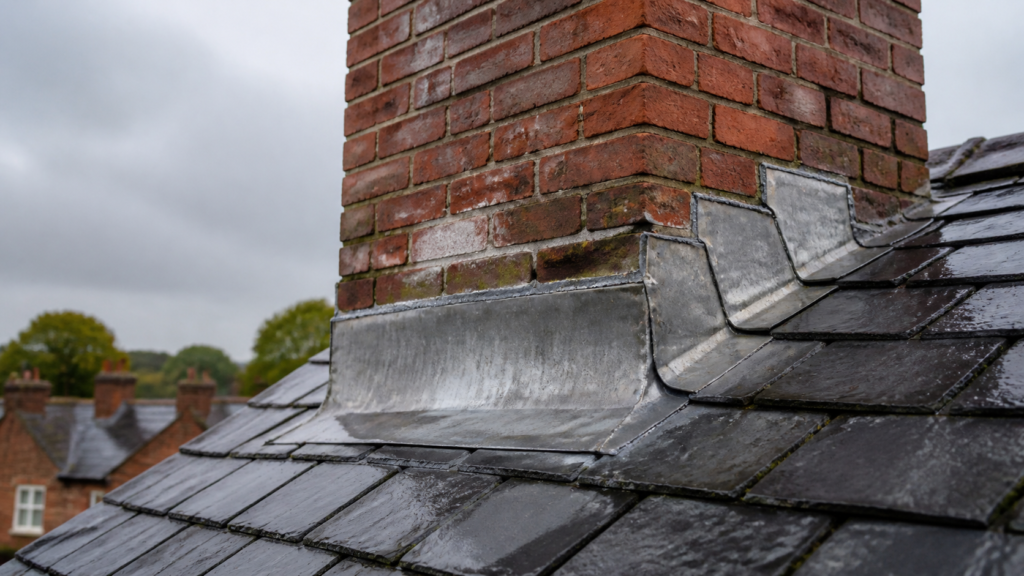
Localised failure at a detail. Slates repeatedly slipping in the same small area, particularly near a chimney, valley or abutment, is more likely a leadwork or detailing fault letting water sit where it should not. That is a genuine repair, and our pages on leadwork and roof flashing and chimney repairs and repointing cover the work involved.
Getting it looked at
The distinction between a roof that needs a repair and a roof that needs re-fixing cannot be made from a photograph, and it should not be made by guesswork. It needs someone on the roof, checking fixings and battens and the condition of the slate itself.
We arrange a free roof survey across Kent and Medway, carried out by approved roofing specialists who are fully insured and appropriately qualified. If your roof is nail sick you will be told so plainly and shown why. If it is not, you will be told that too, and a straightforward roof repair will do the job. Either way the assessment covers the whole slope, not just the gap you noticed, and our roof inspection and survey service gives you it in writing.
For work on slate specifically, see slate and tile roofing. We cover Canterbury, Medway, Maidstone, Ashford, Tunbridge Wells, Thanet and the rest of the county, with more on the Canterbury roofing page, or contact us to book a free roof survey.